
• Skip to main content
  • Skip to primary sidebar
Gun Show Trader logo

Gun Show Trader

The Ultimate Gun Show Resource

  • Gun Laws by State 2026
  • Browse Shows
  • Browse Ranges
  • Newsletter
  • Blog
  • FAQs
  • Advertise

J.S.T. Andrews

The Biology Behind Shooting Accurately

Your body goes through several changes while shooting a gun. These include increased brain activity and heart rate. In addition, your body has to process everything your doing in order to line up the shot.

Let’s explore how shooting effects your body and how to improve your accuracy.

Your Shooting Eye(s)

Do you shoot with your left eye, right eye, or both eyes? Just like a dominant hand, most people will have a dominant eye. The first thing you to determine is which eye is your dominant.

Once determined, use that eye to aim with.

[sym_ads id=”11613″]

Hand-Eye Coordination

Ideally you want to squeeze the trigger with your dominant hand and aim with your dominant eye.

Eye Dominance

It is possible for the dominant eye and the dominant hand to differ. In this case, it can be beneficial to favor the dominant eye.

Example: A right-handed shooter has a left-dominant eye. They may shoot more accurately while using their left-hand and aiming with their left-eye.

Do what works for you.

Aiming Focus

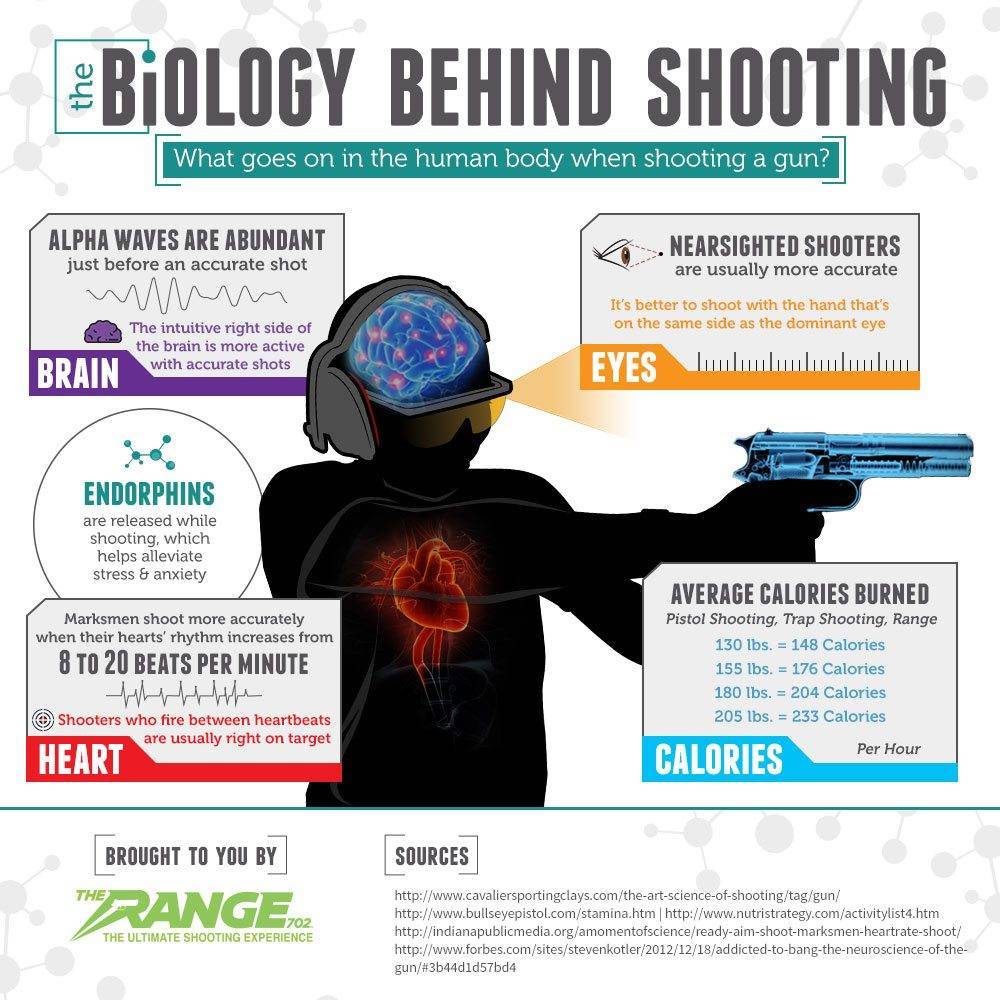
Typically nearsighted shooters are more accurate. This suggests that it’s more beneficial to focus on the sights rather than the target.
Biology Behind Shooting
Infographic courtesy of The Range 702.

Your Brain While Shooting

While shooting your brain releases Dopamine and endorphins. Endorphins are responsible for the feeling of happiness. While Dopamine, a neurotransmitter, causes you to feel a sense of excitement and alertness.

In addition your brain patterns are typically affected.

Alpha Waves are attributed to being in a relaxed state. Research also shows that shooters with an abundance of Alpha Waves are usually more accurate.

Your Heart While Shooting

Shooters whose heart rate that increases between 8 and 20 beats per minute are typically more accurate.

Research also shows that marksmen who fire between heart beats are more accurate.

[sym_ads id=”11614″]

Physical Training

Firing a gun is a physical activity. It requires strength to hold the firearm up and to keep it steady.

Partaking in a an exercise program that targets specific muscle groups may increase performance. It can create better endurance, develop better reactions, and increase your control over the firearm.

Shooting burns anywhere between 148 calories an hour (CPH) and past 233 CPH depending on your weight.

Firearm Shooting Accuracy

There’s an abundance of training videos, books, and articles. However, you should keep to what works best for you. Just remember there are improvements that you can make through practice and training.

Let us know below about your training tips and practices.

Filed Under: Blog Tagged With: Tips

New Feature: Add to Calendar

The Gun Show Trader has added a new feature: Add to Calendar. Visitors will now be able to add an event to their Apple Calendar, Google Calendar, Facebook, Outlook, Outlook.com Calendar, and Yahoo! Calendar. Best of all, it’s completely free.

Update: This feature is currently on available to users who are logged in and registered on our site.

It’s easy to add a gun show to the Calendar. Simple click on the little icon: icon-calendar-t1

A dropdown will pop up. Then click on your preferred calendar.
Add to Calendar Example

Certain calendars, including Apple Calendar, will require you to download a file. Once downloaded this file will allow you to add the event to your calendar.

Filed Under: Site News

New Feature: Verified!

Months ago the Gun Show Trader started a new campaign. Every week our staff goes through each gun show for the upcoming weekend and double checks all the information. This information includes (but is not limited to) dates, times, and location. All the new/changed information for the gun show was updated.

On average one cancelled gun show was found every week. In most cases the gun show was either cancelled and/or postponed. Our staff promptly updated the information. However, not all information could be verified. So our staff started emailing promoters every week as well. Although this doesn’t cover all gun show listing, it certainly covers a vast majority of them.

Thanks to the overwhelming response from the gun show promoters, we developed: Verified!

Every gun show that has been verified by our staff will receive a blue, text underneath the title saying “Verified!” This will help all gun show attendees, and vendors be confident in their travels. Hopefully this will create a better gun show experience.

Keep in mind, it is still best practice to verify all information with the gun show promoter directly. Especially when you are traveling long distances.

Filed Under: Site News

How to get a Concealed Carry Permit

This is a general guide on how to get a concealed carry permit. It is imperative to know that each state handles it differently, and this is only a basic overview.

There’s a lot to consider when one stats the process of getting a concealed carry permit. As they say, “With great power, comes great responsibility.” Not only does one have to recognize the moral responsibility, but also the laws that come with a concealed carry license.

Before you get started, know this won’t be an easy process. It’s just like any other government issued permit or license, one has to jump through rings of fire. Each state does this process differently.

Check Your State’s Laws

First thing that you have to do is familiarize yourself with the gun laws in your state. Pay close attention to your state’s carry laws and know how your state issues permits. There are three (3) types of states that issue permits.

Shall Issue States

These states shall issue you a concealed carry permit if you pass the background check, with as a few additional steps (depending on the state). These states include: Alabama, Alaska, Arizona, Arkansas, Colorado, Florida, Georgia, Guam, Idaho, Illinois, Indiana, Iowa, Kansas, Kentucky, Louisiana, Maine, Michigan, Minnesota, Mississippi, Missouri, Montana, Nebraska, Nevada, New Hampshire, New Mexico, North Carolina, North Dakota, Ohio, Oklahoma, Oregon, Pennsylvania, South Carolina, South Dakota, Tennessee, Texas, Utah, Vermont, Virginia, Washington, West Virginia, Wisconsin, and Wyoming.

May Issue States

The states in this category may issue a permit if they deem fit. Each state is different, and some almost impossible. The May Issue States include: California, Connecticut, Delaware, District of Columbia, Hawaii, Maryland, Massachusetts, New Jersey, New York, Puerto Rico, Rhode Island, and the U.S. Virgin Islands.

Rights Denied States

These states/territories deny rights to a concealed carry permit. These states include: American Samoa, District of Columbia, and N. Mariana Islands.

Steps to Take

  1. Identify the permitting authority: USACarry.com.
  2. Fill out your state’s application.
  3. Take a gun safety course (may require certificate for application).
  4. Fingerprint Card (may be required).
  5. Passport-style photo (if required).
  6. Pay Required Fees (usually sent in with the document).
  7. Military ID and station location paperwork (if required).

Generalized Requirements

This can’t be emphasized enough: Check your state’s process. Below are general assumptions.

  • Be 21 years of age or older at time of application.
  • Be a United States citizen or a permanent resident alien with permanent resident card or “green card.”
  • Have no pending trial, appeal, or sentencing on a charge that would prohibit you from having a license.
  • Have no outstanding warrants for any charge, from any court.
  • Have no court order or injunction against possessing a firearm.
  • Have no mental health conditions that would prohibit you from having a license.
  • Have no felony convictions, or adjudications for a felony offense, in this state or elsewhere. “Felony” means any felony offense under the laws of Washington, or any federal or out-of-state offense comparable to a felony offense under the laws of Washington.
  • Have no convictions for any of the following crimes committed by one family member against another on or after July 1, 1993:
    • Assault IV
    • Coercion
    • Stalking
    • Reckless Endangerment
    • Criminal Trespass in the first degree
    • Violation of the provisions of a protection order or no-contact order restraining the person or excluding the person from the residence

It is also important to keep in mind the emotional, financial, and legal obligations involved in getting a concealed weapons license.

Filed Under: Blog Tagged With: Concealed Carry

13 Misused Gun Terms

The following are standard definitions of the most common missed gun terms. They have been put astray from the original meaning. Sometimes the truth is distorted via the media. Others are just simple confusions and common inaccuracies. This is great place to start if you’re speaking or writing about firearms and their associated topics. Refer to these definitions in order to offer a clear and uniform point of view free of preconception.

[sym_ads id=”11613″]

All persons including veteran gun owner to someone who is just starting out has at some point misused gun terms. Knowledge is power. Get to know these terms and definitions. It’ll help carry on a conversation free from prejudice and inaccuracy.

Clip vs. Magazine

Magazine vs ClipYou’ll often hear these two terms being used in a synonymous way, but here’s the thing: they’re not the same. Yes, they both hold ammunition, but neither of these look alike or function in the same way. They are not interchangeable sources. A magazine is an enclosed container that has a feed spring within it, a follower and feed lips; after firing the first round, the recoil forces the slide back, ejecting the spent cartridge. When the slide moved forward again, the gun’s recoil force-feeds a new live round from magazine to chamber.

Clips, on the other hand, have no spring. They do not feed shells directly into the chamber. Instead, the clips hold cartridges in the correct place to be pulled through the specific firearm’s magazine. They don’t stay in the gun once you’ve loaded the rifle’s magazine. Stripper clips allow for the rounds to be “stripped” into the magazine, which means they’re fed into the magazine itself, and not firearm.

[sym_ads id=”11614″]

An easy way to remember these terms is as goes: Clips feed magazines; magazines feed the firearm.

Assault Rifles vs. Semi-Automatic Rifles

Clinton Signing Federal Assault Weapons Ban
“Assault Rifle” is a commonly misused term in conversations regarding firearms, and certainly one of the most harmful in relation to public perception, but it’s definition is simple and matter-of-fact: a military issued selective fire or fully automatic rifle with a short overall length designed to fire a reduced power rifle cartridge. As for the term “assault weapon” it clearly means nothing, and it’s closest term has been defined above.

“Assault rifles are short, compact, select-fire (i.e. both semi-automatic and full-automatic) weapons that fire a cartridge intermediate in power between submachinegun and rifle cartridges.” as the U.S. Army defines it. That means that AR-15’s and other civilian rifles do not apply. They are semi-automatic (“self-loading”), meaning they fire once from a self-contained magazine and reload automatically until ammunition supply is exhausted. Often, they’re incorrectly referred to as machine guns.

Automatic vs. Semi-Automatic

M2 Browning Machine Gun
The Browning M2 is a fully automatic machine gun.
Automatic weapons, also knows as machine guns, are military weapons that are capable of firing until running out of ammunition, so long as the trigger on the firearm is pushed down. All around the world these weapons are usually found only on a battlefield.

Semi-automatic weapons, however, are civilian weapons. They are less capable of continuous firing, and although the firearm automatically reloads itself, the shooter must pull the trigger each time in order to for another round. Semi-automatics are usually pistols, rifles and shotguns (AK-47, AR-15 and MAC-10 machine pistols).

Generally speaking, there are two types of machine and semi-automatic guns: recoil-operated and gas-powered. Recoil-operated causes a “blowback” or recoil that occurs when a shot is fired and sends the barrel backward rapidly, ejecting the empty shell casing and loading a new live round into the chamber. Gas-operated guns harness the gas from a fired round to drive a piston into the weapon’s barrel, ejecting the spent shell and cocking a fresh one. These automatic loading features mean that the user doesn’t need to cock the weapon hammer in order to load a new live round.

Military vs. Military Style

US Army Military WeaponHaving a “military style” rifle isn’t the same having a military weapon, and most times someone uses the term “military style” they want you to associate it with the power of a military-grade weapon. The difference, to name one, is that “military style” rifles do not have the firing modes that allow you to shoot multiple bullets from a single press of the trigger (full-auto, 3 shot burst).

Military rifles have to meet a list of specific requirements to be considered, and this always includes features that will be useful to the soldier in the field; most of these requirements would be useless to a civilian, anyway. In all likelihood, your military-looking rifle was simply fashioned to resemble something you’d see in the military, but their operations are not the same.

High Capacity vs. Standard Capacity

Ruger SR9
Standard capacity on a Ruger SR9 is 17+1.
First of all, there is no such thing as “high-capacity ammunition” or “high-capacity weapons.” Ammunition (bullets) has one capacity, and that is to hit a target. High capacity is in reference only to magazines, which is the device that feeds the ammunition into the firearm.

Weapons come furnished with a magazine that holds 10-17 rounds, making that the standard for the weapon. However, there are certain magazines that can hold up to 33 rounds, making it a high capacity magazine. The term is oftentimes misused by the media to refer to any firearm feeding device holding more than whatever number of cartridges they deem to be unnecessary.

Pistol vs. Handgun

Remington M1911A1
Remington M1911A1
In the debate of Pistols vs. Handguns there are many people who use “handgun” to describe any hand-held firearm, but use “pistol” only in reference to semi-automatic handguns. While there’s some debate over this, it’s best to say that the term itself is one of personal preference.

The NRA Firearms Sourcebook defines a pistol as “a generic term for a hand-held firearm. Often used more specifically to refer to a single-shot, revolver or semi-automatic handgun.”

In the late 16th century the term “pistol” was widely used to describe hand-held guns, and then Samuel Colt described his cylinder-firearm invention as the “revolving pistol.” The word pistol is clearly an established term within the world of firearms, coming along far before the semi-automatic handgun, so it would be a safe bet to say that all handguns are pistols, and that all pistols are handguns.

Handle vs. Grip

Beretta M9 GripWhile a grip is technically a handle, grip is the proper term for the part of the gun that you hold in your hand. Grip can also refer to how you hold your gun; when holding a gun properly, which you should always be doing.

Handle isn’t tossed out of the lexicon of gun terminology, though. There are times when someone may post the questions “how does that gun handle?” or “can you handle a gun?” to which you can answer yes if you know how to safely operate, aim and hit a target. As for how a gun handles, well that you’re personal opinion about how a gun shoots.

Accuracy vs. Precision

Indoor Pistol RangeWhile these two terms are often used interchangeably, they describe two separate aspects of landing shots on a target. Accuracy is the measurement of the shooter’s ability to hit a given target consistently; precision is the tightness of those shot-groups (how close together the shots place).

An example in their difference is this:

  1. If a rifleman were to shoot all across the target, landing hits in several scattered places, there is no precision or accuracy.
  2. If he were to hit the target and land a tight four-shot group, he is accurate but imprecise due to not hitting the center.
  3. If the rifleman lands a close four-shot group in the corner of the target that is precise, but inaccurate due to being off-center.
  4. The rifleman lands a tight four-shot hit to the direct center of the target he has both accuracy and preciseness.

Rifles that can consistently hit their target in close groups may often be described as accurate, but it’s actually an indication of good precision instead.

Bullet vs. Cartridge vs. Caliber

Bullet vs. Cartridge vs. CaliberThere are a number of differences between the terms “bullet,” “cartridge” and “caliber.” Yet it’s common to hear these terms being used in the wrong way by people that seem to not know any better, or simply don’t care what they’re asking for. A bullet is a simple projectile that exits the barrel. It’s a non-spherical chunk of metal or other material intended for use within a rifled barrel.

The caliber is the measurement of the bullet’s diameter, usually expressed in millimeters or hundredths of an inch.

Bullets and cartridges have to do with one another, but bullets are merely a component of the cartridge itself. Cartridges consist of a case, primer, propellant and projectile; bullets are within the cartridge case. Cartridge is also a term that can be used to accurately describe any shotshell.

Shells vs. Shotshells

Shotgun ShellShells and Shotshells are often confused due to the similarity of the words, but there are differences between them. Most people operate under the impression that “shells” only refer to shotgun cartridges, but those are actually what shotshells are for; generally referring to a round of shotgun ammunition, most accurately ones containing pellets rather than a slug or other projectile.

“Shells” is the accurate term for any handgun, rifle or shotgun cartridge or cartridge case, which is explained above in Bullet vs. Cartridge vs. Caliber.

Suppressor vs. Silencer

SilencerCo Suppressor on Springfield 1911There are reasons why these terms get mixed up so often, and that’s probably because numerous sources (i.e: NRA Firearms Sourcebook and The Bureau of Alcohol, Tobacco, Firearms and Explosives) have opposing views on the terms. For the sake of clarity, we’re going to go with the distinction made by the NRA Firearms Sourcebook: “a device attached to the muzzle of a firearm to reduce the noise of discharge. Sometimes incorrectly called a ‘silencer.'”

Guns that fire in complete silence do not exist, so it’s best to eradicate the word itself from your vocabulary when referring to this device. The suppressor, commonly termed as a silencer, merely “suppresses” the escaping gases, reducing but not eliminating the noise of the discharge.

Kick vs. Recoil

kickThis is a matter of general colloquialism and personal taste, though to be literal there is no way that a gun can kick you back by definition alone: it has no feet.

The force that is created within the gun’s chamber due to expanding gases causes the gun to physically push back toward your hand, bringing people to coin it as a “kickback” or kick for short. The proper term for this push of force caused by the bullet exiting the barrel is the recoil.

Extractor vs. Ejector

Extractor vs EjectorThese two words, often used in exchange for one another, are very far apart in their purpose. The extractor does not eject the spent shells, rather, in most firearms the extractor hooks onto the head of a chambered cartridge and pulls it back as the action goes through it’s cycle. The extractor does not eject the spent casing because that is what the ejector does.

In semi-automatic weaponry, the ejector is a small blade positioned opposite the ejection port. The extractor pulls the shell toward the rear of the gun until it meets with the ejector, which will release the port. However, there are exceptions when it comes to this. Double-barrel shotguns are known to be extractors-only; the chamber is designed to slightly extract spent shells, making it easier for the shooter to remove it from the chamber. Some other double-barrel shotguns have built-in ejectors that will spring the spent shells from the gun, making it unnecessary to have an extractor.

Filed Under: Blog

Gun Law Book Review

I got a wonderful opportunity to review the gun law book “Gun Laws by State.” You should have at least heard of it by now. If not, then this Gun Law Book review is perfect for you.

[sym_ads id=”11613″]

The book covers all 50 states in the United States. It also covers questions concerning reciprocal carry and interstate transportation. In addition to state and federal gun laws, the book also covers information on federal property among other gun law topics.

This review will be completely unbiased. In this Gun Laws by State review, I’ll let you know who this book will be good for, and also who this book might not be good for. Most likely if you’re on the Gun Show Trader, this book will benefit you in some way.

Gun Law Book Review: Initial Thoughts

When I first received the book I immediately began reading. At first the book seemed like it was all legal jargon. I wasn’t the biggest fan. However, I kept at it.

After a few pages it began to make sense as I eased into it. Within the first few minutes I was quickly won over. I learned way more about gun laws in the United States than I even thought possible.

[sym_ads id=”11614″]

Start from the Beginning

Gun Law Book ReviewThe book has several sections even before the Table of Contents. I suggest you read every bit of it. This includes the Terms of Access and Use pages.

Before Chapter One, the “Gun Laws by State” include recent trends for the current year. This was surprisingly helpful in order to understand why current laws are in motion.

It also includes explanations of specific terms used throughout the book. It’s a short section and well worth the time. It’ll make your read easier while going through the book.

When your are driving in a state that has a slower speed limit… That other state’s law applies. Your driver’s license is recognized only to allow you to drive there.

  • Retreat vs Stand Your Ground
  • Individual State Laws
  • Transportation including buslines, airlines and private transportation.
  • Myth Busters Section

Read It Entirely

I would suggest that everyone read the “Gun Laws by State” in its entirety. Even if you have only lived in a single state, have never left that state, and never plan on leaving that state you should read this book completely. Not only will it give you a better understanding on how gun laws work in this country, but it will also help you to understand gun laws in your own state.

Review it when Traveling

The single greatest part of this book is being able to review it when traveling. I’m getting ready to take a trip here in a few weeks. Since this is trip is going to take me across several state lines I’ll be reading up on each state’s gun laws. That alone is worth the price of the book.

Gun Laws by State Price

At the time of this review Updated for 2017:

  • Physical Paperback: $20.00

Purchase “Gun Laws by State”

Who Should Buy This Book?

  • Anyone who owns a firearm
  • Anyone who has a Concealed Carry
  • Anyone who travels with their firearm(s)

Who This Book Isn’t For

  • Non-firearm owners
  • Anyone looking for “loopholes”

Thank You

I hope you enjoyed this review. Let me know in the comments below what you think and how you like the book.

Filed Under: Blog

  • Go to page 1
  • Go to page 2
  • Go to page 3
  • Interim pages omitted …
  • Go to page 5
  • Go to Next Page »

Primary Sidebar


Advertise

Get your shows noticed and your products sold. We have both email advertising and premium listings available.

  • Privacy Policy
  • Terms of Service
  • Sitemap
  • Contact Us
  • Log in

Copyright © 2026. RED ATX Enterprises, LLC. All Rights Reserved.